

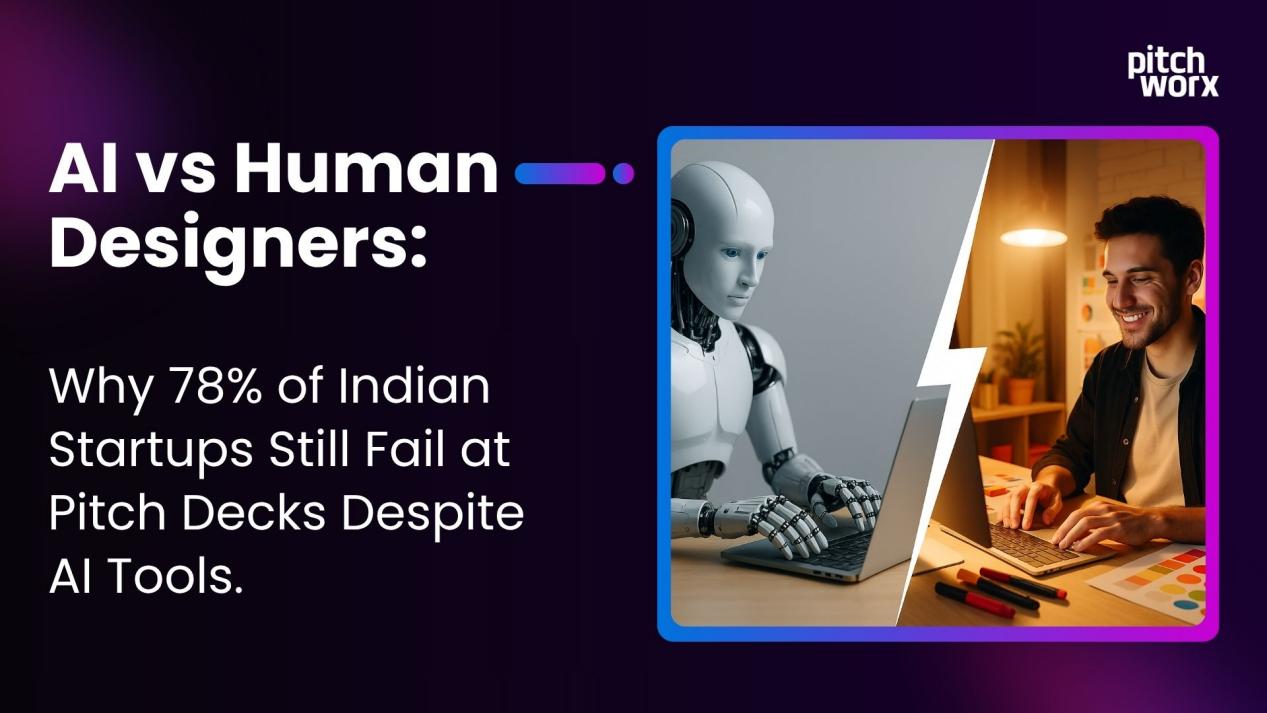
In the last few years, India’s startup ecosystem has seen a surge in the use of AI-powered pitch deck tools like Slidebean, Beautiful.ai, Tome, and Pitch. These platforms promise quick, sleek, and “investor-ready” presentations at the click of a button. For founders juggling product development, hiring, and growth, the convenience is irresistible. But beneath this rising trend lies a surprising reality.
According to Delhi-based presentation design firm PitchWorx, which has analyzed 150,000+ slides over 13 years as a leading pitch deck design agency, a staggering 78% of Indian startups continue to get rejected by investors due to pitch-related issues. This isn’t because the slides look bad. It’s because the story behind the slides is fundamentally flawed. And that’s where AI falls short.
The Rise of AI-Generated Pitch Decks
AI has transformed content creation—with pitch decks becoming one of its biggest use cases. Platforms like Beautiful.ai and Slidebean allow founders to:
• Auto-generate slide layouts
• Access pitch templates used by unicorns
• Convert prompts into slides
• Ensure visual consistency and clean formatting
This is undeniably helpful. For overworked founders, AI acts as a design assistant—quick, affordable, and accessible.
But investors aren’t rejecting decks because they lack aesthetic polish. In fact, today’s AI-generated slides often look more professional than what many early-stage founders used to create manually. So why do these rejections keep happening?
The Missing Link: Strategic Storytelling
- PitchWorx’s research shows that most failed decks share one common issue:
- The story doesn’t make sense from an investor’s perspective.
- A pitch deck isn’t a design project. It’s a narrative about your business viability.
While AI tools are excellent at generating content structure or visual appeal, they are not equipped to understand the deeper layers of:
• Market logic
• Business model robustness
• Product-market fit
• Competitive differentiation
• Financial defensibility
• Scalability
• Founder psychology and conviction
AI can’t stress-test assumptions, identify market gaps, or warn you when your solution doesn’t match your problem statement.
As PitchWorx analysts highlight, most bad decks fail not at the design level, but at the thinking level. Many founders assume presentation design services alone can solve pitch issues—but strategy, not visuals, is the core problem.
• The Illusion of “Good Enough”
• AI tools give founders what feels like a shortcut.
• You upload rough content → AI formats it → You download a polished deck.
• It looks great. It feels investor-ready.
But this creates a dangerous illusion:
- If something looks professional, founders assume it is professional.
- However, investors evaluate decks in a very different way.
- A VC is not looking at fonts, color palettes, or layout symmetry.
They scan for:
• Is the problem real, urgent, and costly?
• Is the market large and underserved?
• Does the solution solve the problem better than today’s options?
• Is the business model sustainable and scalable?
• Does the founding team demonstrate clarity, grit, and domain intuition?
• Do the financials and projections reflect grounded reality?
These judgment calls require strategic clarity and founder insight—none of which can be auto-generated by AI.
Why AI Fails at Investor Logic
AI tools operate on pattern recognition. They remix ideas from existing decks, blogs, or templates. But investor thinking is non-linear, contextual, and deeply intuitive.
For example:
A founder may describe their market as “$20B and growing,” but a seasoned VC instantly knows that the actual serviceable market could be as small as $150M after segmentation. AI wouldn’t flag that.
Or AI may suggest “competitive advantages” based on generic strengths like “easy to use” or “AI-driven insights,” which investors dismiss in seconds.
• AI can produce slides.
• It cannot produce strategy.
Investors Reject Decks for Reasons AI Cannot Predict
PitchWorx’s insights show the most frequent investor complaints:
- “They don’t understand their market.”
- “Weak or unrealistic projections.”
- “The problem and solution don’t match.”
- “The pitch is too generic—like something copied.”
- “They didn’t answer the ‘why now’ question.”
- “Team slides don’t build confidence.”
- “Deck feels like a fancy brochure, not a business pitch.”
Notice how none of these issues are design-related.
AI Is a Tool—Not a Pitch Strategist
AI can assist. It can accelerate. It can polish.
• But it cannot replace:
• Founder clarity
• Market depth
• Business thinking
• Narrative flow
• Storytelling strategy
• Investor empathy
Successful pitch decks—from Uber to Airbnb to Dropbox—weren’t powerful because they were well-designed. They were powerful because the thinking was clear, crisp, and compelling.
Founders who raised millions didn’t rely on templates.
They relied on strategy.
• The Future: AI + Human Strategy, Not AI Alone
• AI is here to stay.

But PitchWorx’s data reminds us of a crucial truth:
• A deck designed beautifully but built on weak thinking is still a weak deck.
• The real revolution will happen when founders combine:
• AI for speed and design
• Human expertise for strategy and storytelling
Templates cannot differentiate you in a saturated fundraising landscape.
A compelling narrative can.
The Indian startup ecosystem is entering a phase where storytelling matters more than ever. Funding is becoming selective, investors are more critical, and market competition is brutal.
While AI pitch deck generators offer speed and convenience, they cannot fix the root cause of most fundraising failures: strategic storytelling gaps.
Until founders focus on clarity of thought—supported by experts who understand investor psychology—no amount of design automation will move the fundraising needle.
