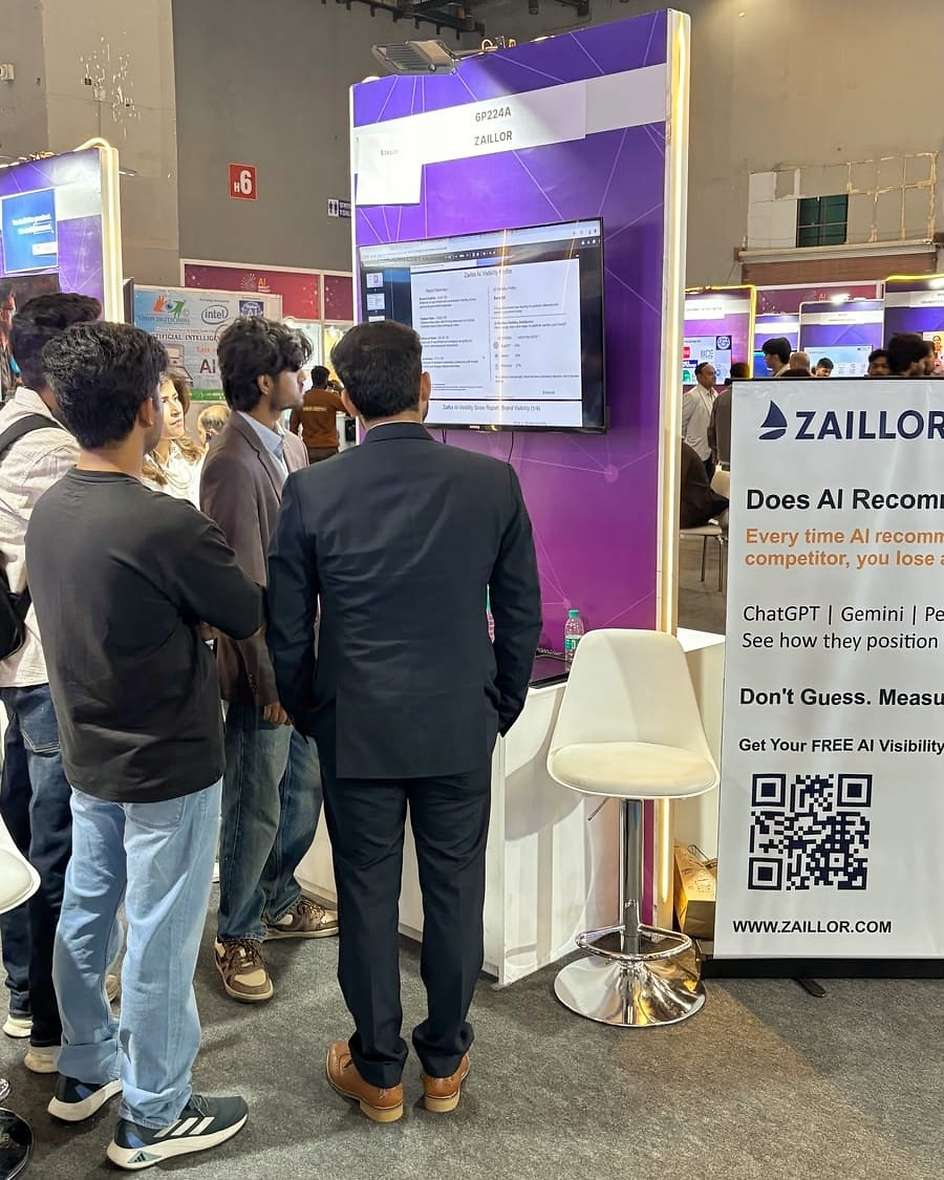
NEW DELHI, June 2026 · A business can have excellent products, a well-designed website, and a strong reputation, and still not appear in an AI response, if the machine-readable signals that AI systems rely on are absent or inconsistent. A new study by Zaillor, an AI visibility research and optimisation firm, has found that the overwhelming majority of Indian small and mid-sized enterprises (SMEs) are effectively invisible to the AI systems that millions of people now use to discover, research, and shortlist businesses.
The study assessed AI Visibility Scores across 700 Indian SMEs spanning eight sectors, and found that only 5% of businesses achieve what Zaillor classifies as strong AI presence. The remaining 95% are either weakly surfaced or inconsistently visible across ChatGPT, Gemini, and Claude.
The average AI Visibility Score across the cohort was 50.4 out of 100, placing the typical Indian SME in the borderline low-to-moderate range. In practical terms, this means that when a potential customer asks an AI assistant to recommend a healthcare provider, an accountant, a fintech service, or a software vendor, the majority of Indian businesses in those categories are unlikely to appear in the response.
What Is AI Visibility?
When someone asks ChatGPT, Gemini, or Claude to recommend a doctor, a software tool, or a financial service, those platforms pull from a combination of training data and live web signals to construct an answer. AI Visibility refers to how prominently and accurately a business appears in those responses.
It is distinct from traditional SEO, which focuses on ranking in search engine results pages. AI systems do not show a ranked list. They surface a small set of named brands, or none at all. A business that ranks well on Google may still be effectively absent from AI-generated responses if the structural signals AI systems rely on are not in place.
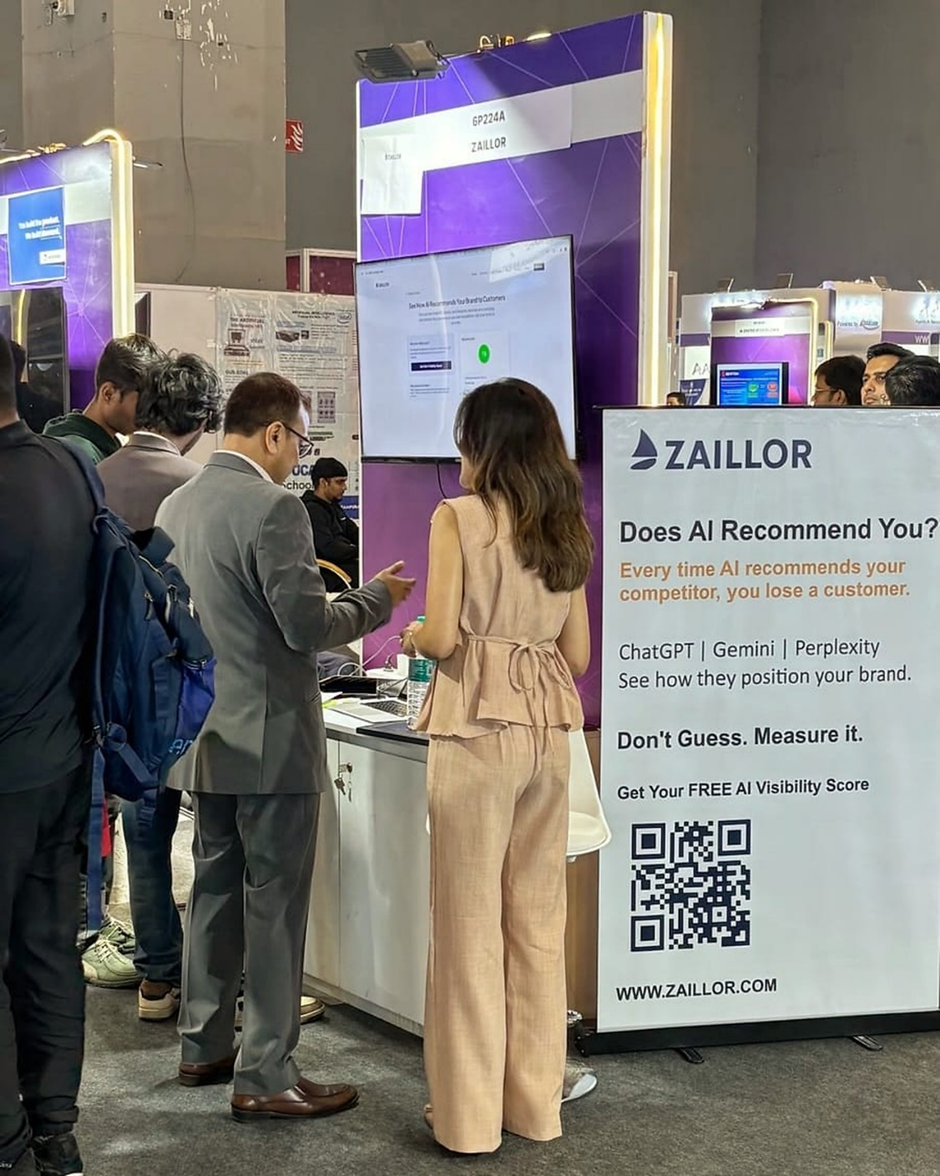
Fig; Zaillor team guiding Indian business owners with their AI visibility at the AI Impact Summit 2026 held at Bharat Mandapam, New Delhi
Key Findings
- 50.4
Average AI Visibility Score out of 100 across 700 Indian SMEs
- 61%
Fall below effective visibility threshold
- 5%
Achieve strong AI presence (High band, 71–100)
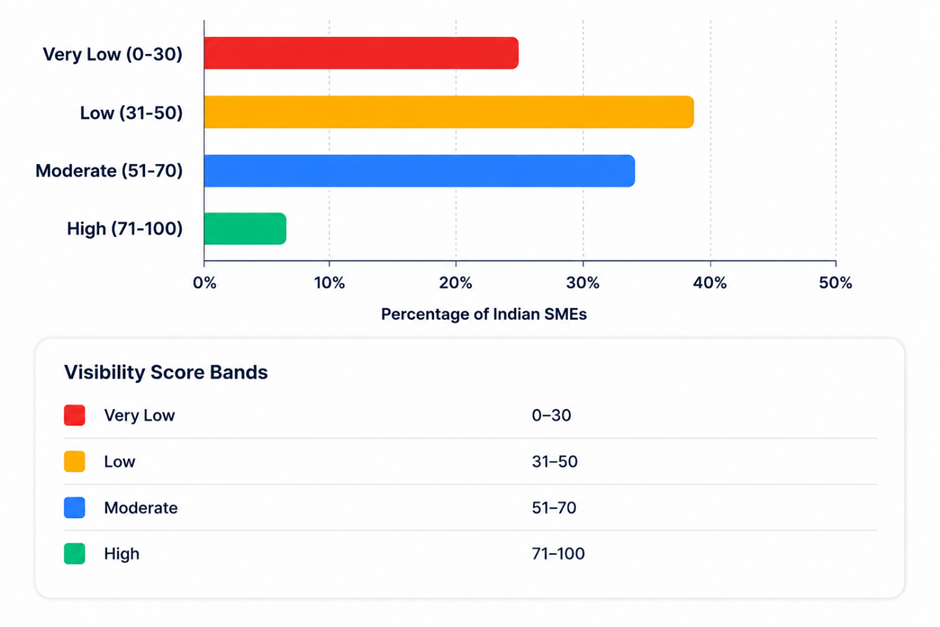
Figure 1: Distribution of AI Visibility Scores across 700 Indian SMEs (Source: Zaillor, 2026)
The research, titled The 2026 AI Brand Visibility Snapshot: Indian SMEs, was produced by Zaillor across the period February to May 2026. The cohort was seeded at the AI Impact Summit 2026 in New Delhi and tracked continuously through May 2026, with AI Visibility assessments updated to reflect evolving platform behaviour across ChatGPT, Gemini, and Claude. The dataset captures point-in-time visibility based on publicly available, machine-readable signals at the time of analysis.
AI Discoverability Varies Sharply Across Sectors
The data shows that AI discoverability is not evenly distributed across Indian business categories. Consumer-facing and trust-heavy sectors, which carry more publicly available, third-party validated information, appear significantly more visible to AI systems than digitally native but niche sectors.
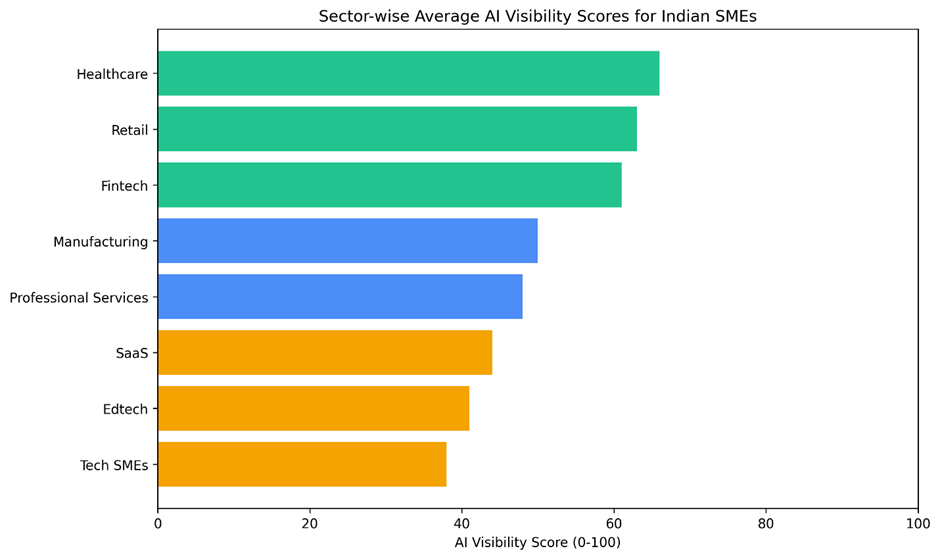
Figure 2: Sector-wise average AI Visibility Scores for Indian SMEs (Source: Zaillor, 2026)
The pattern suggests a structural advantage for sectors with high external citation density, reviews, directory listings, and regulatory or media coverage. Healthcare, Retail, and Fintech lead visibility rankings. SaaS, Edtech, and Tech SMEs trail significantly, despite often having stronger websites than their higher-visibility counterparts.
Zaillor's analysis identifies this as a signal density problem rather than a quality problem. AI systems surface what is cited, structured, and consistently positioned across the web. Sectors with high consumer interaction naturally accumulate more of these signals. Digitally native but niche sectors must build them deliberately.
“The data shows that AI discoverability is already highly concentrated. A small number of businesses are structurally positioned to capture AI-driven recommendations, while the majority remain absent from the responses that are increasingly shaping purchasing decisions.”
— Zaillor, 2026 AI Brand Visibility Snapshot
Why This Matters for Indian Businesses in 2026
AI search is no longer a technology trend. It is becoming a primary discovery channel. ChatGPT crossed 900 million weekly active users globally in early 2026. AI search visits grew 42.8% year over year between Q1 2025 and Q1 2026. For Indian businesses competing in one of the world’s fastest-growing digital economies, the shift represents both a significant risk and a structural opportunity.
The risk is straightforward. As more people use AI assistants to find services, book appointments, evaluate vendors, and shortlist products, businesses that do not appear in AI responses lose discovery opportunities entirely. Unlike traditional search, where a business might rank on page two or three and still attract some traffic, AI responses typically surface a handful of recommendations. A business that is not in that set may not exist from the user’s perspective.
The opportunity is equally significant. Zaillor’s data indicates that AI discoverability is currently concentrated in a very small fraction of Indian SMEs. This means the window for first-mover advantage remains open. Businesses that build structured AI visibility now, before the category matures, are positioned to capture disproportionate share of AI-driven discovery.
Three Implications for Indian SMEs
- First-mover advantage is real and time-limited. SMEs that establish structured AI visibility now will be recommended ahead of competitors as AI-driven research becomes standard. This advantage will narrow as more businesses catch up.
- Structured digital presence is now competitive infrastructure. AI systems rely on machine-readable signals: schema markup, consistent entity data, and authoritative third-party citations. These are no longer optional for discoverable businesses.
- Ongoing monitoring is necessary, not optional. AI platform behaviour evolves rapidly. Point-in-time improvements decay without active maintenance. Regular visibility assessment is a new category of business hygiene.
Top Structural Gaps Identified for Small and Medium Enterprises
Across the 700-business dataset, Zaillor identified five recurring structural gaps that explain why most Indian SMEs fall below the effective AI visibility threshold:
- Limited structured online presence
Absence of schema markup, structured data, and machine-readable business information. AI systems cannot reliably interpret what a business does, who it serves, or where it operates without these signals.
- Inconsistent brand messaging
Fragmented positioning across website, directories, and third-party platforms reduces AI’s ability to form a coherent understanding of the brand. Contradictory signals produce low-confidence, inconsistent surfacing.
- Low citation and reference density
Minimal third-party mentions, reviews, and authoritative references that AI models rely on for validation. Consumer sectors, which benefit from reviews and press, outperform B2B sectors partly for this reason.
- Weak category positioning
Digitally native sectors in particular suffer from insufficient category clarity. If AI systems cannot confidently place a business within a recognisable category, they are unlikely to surface it in response to category-level queries.
- Absence of crawlability signals
No robots.txt guidance for AI crawlers, missing or outdated sitemaps, and no llms.txt file. These technical signals tell AI systems what content exists and what to prioritise. Without them, even well-written content may remain effectively invisible.
Methodology
The 2026 AI Brand Visibility Snapshot: Indian SMEs was produced by Zaillor using its AI Visibility Score framework. The study cohort was seeded at the AI Impact Summit 2026 in New Delhi (16–20 February 2026) and tracked continuously through May 2026. Participants represented a cross-section of India’s SME economy, from digital-first businesses in SaaS, fintech, and edtech through to manufacturing, healthcare, retail, and professional services.
AI Visibility Scores were generated based on assessment of publicly available, machine-readable signals across ChatGPT, Gemini, and Claude at each measurement point. Scores reflect how AI systems may reference and surface brands given available signals at time of analysis. Results represent aggregated observations across the dataset and do not constitute factual verification of individual company performance, regulatory standing, or market position.
Cohort size: 700 Indian SMEs. Assessment period: February–May 2026.
About Zaillor
Zaillor is an AI Visibility Optimization company. Zaillor measures how AI platforms including ChatGPT, Gemini, and Claude currently describe and surface a brand, identifies the structural gaps that limit discoverability, and implements the content, technical, and semantic changes needed to improve AI citation and recommendation across platforms.
Zaillor helps brands become more visible and get recommended by AI platforms like ChatGPT, Gemini, and Claude.
Website: zaillor.com
Report: zaillor.com/insights
Media Contact
Zaillor Communications
For press enquiries, report access, data requests, or interview scheduling: support@zaillor.com or +91 9560205528